


Most HR leaders are waiting for the premiere to see if their AI strategy is a hit. The smartest ones already know the ending. New data proves that your implementation history writes your future.
The Allure of the AI Premiere
The house lights dim. The music swells. On the screen, the promises of Artificial Intelligence for Human Resources flash in brilliant technicolor, captivating the C-suite and business leaders alike. Imagine an HR function that can predict skill gaps before they widen, write perfect job descriptions in seconds, slash time-to-hire, and solve employee retention. This is the blockbuster premiere every HR organization wants to attend, a future where AI handles the administrative burden, freeing HR to become a truly strategic partner. The expectations are sky-high, and the potential ROI seems limitless. Every Enterprise Software vendor from SAP to Workday, Oracle and more are showing a captivating AI movie trailer, but the realization of value in these projects is varied across the industry.
You Can’t Start Your AI Movie in the Middle
But here’s the plot twist many executives miss: you cannot start this movie in the middle. Before the AI hero can fly, it needs an origin story. Think of Tony Stark building his first suit in a cave—the gritty, foundational work that made everything else possible. For AI in HR, that crucial prequel is a successful, strategic Human Capital Management (HCM) implementation. It’s the essential, non-negotiable first act. Skipping this step, according to extensive data from industry analyst firm Raven Intelligence, is the fastest way to ensure your AI blockbuster fails before it even begins.
Why Implementation is the Real Hero
Let’s be honest: implementation isn’t a glamorous concept. It conjures images of Gantt charts, process mapping workshops, and data cleansing spreadsheets—the behind-the-scenes work that rarely makes the final cut. The temptation to rush through this phase to get to the “exciting” AI features is immense, but it’s a critical mistake.
Deploying a powerful AI tool without a solid implementation is like installing a Ferrari engine in a car with a rusted-out transmission and leaky fuel lines. The engine has immense power, but it has no way to connect to the wheels. A strategic implementation isn’t just about data cleansing; it’s about codifying your business logic. It harmonizes job architectures, standardizes performance metrics, and defines talent processes. This isn’t administrative groundwork; it’s the process of building the digital nervous system upon which AI will later rely for context and decision-making.
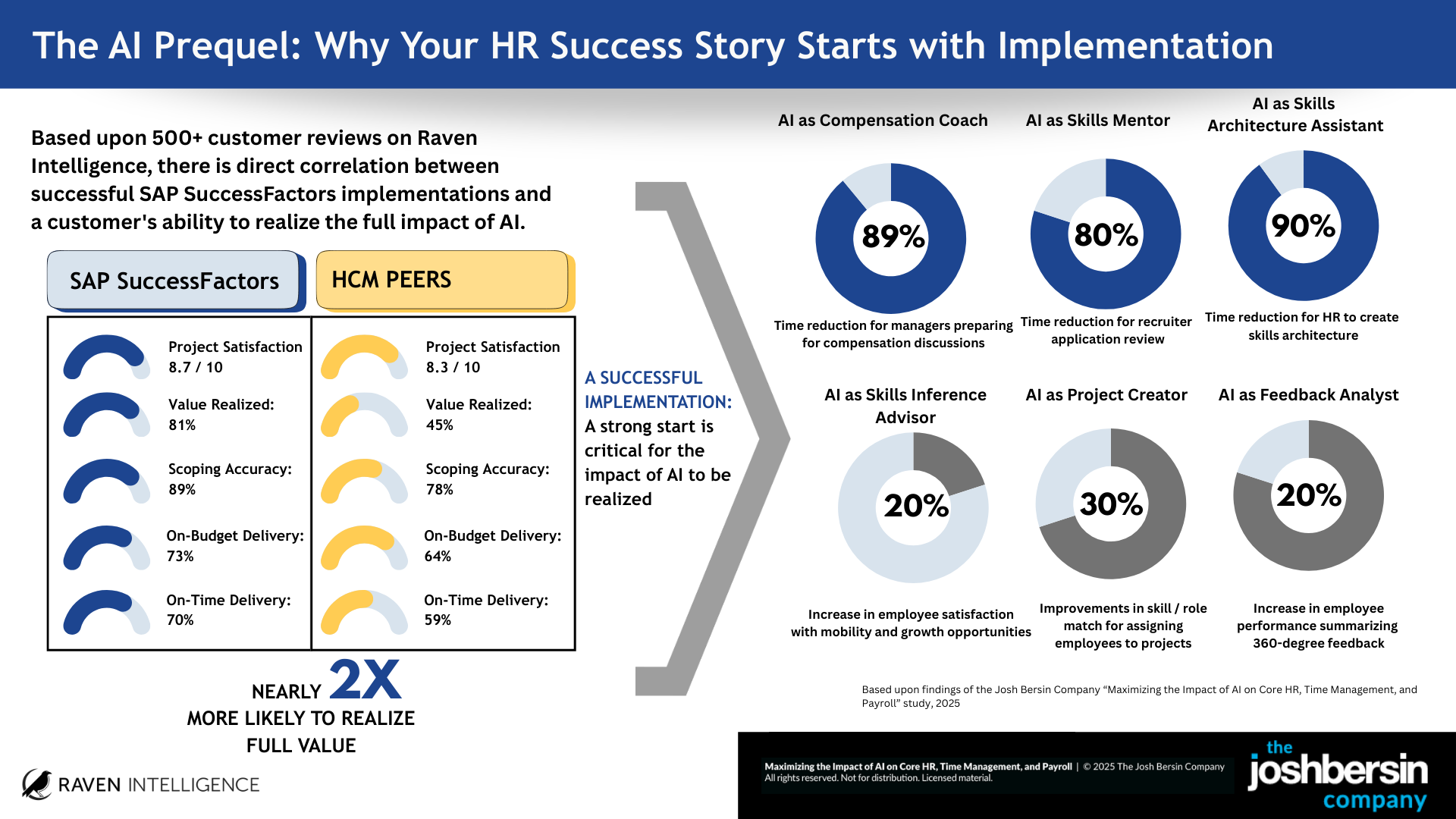
This isn’t just an analogy. Hard data from hundreds of projects reveals a clear line between implementation discipline and AI-driven results.
The Data Behind the Drama: Proof from the Field
This isn’t just anecdotal advice. The link between a high-quality HCM implementation and successful AI adoption is substantiated by hard data and real-world results. Let’s examine the proof.
a. The Data Foundation: Good Governance Breeds Great AI
Projects that prioritize data governance and process standardization from the outset see dramatically higher satisfaction with their technology and are better positioned for AI. As The Josh Bersin Company notes, building a technology stack is like building a house—without a strong foundation, it can fall apart.
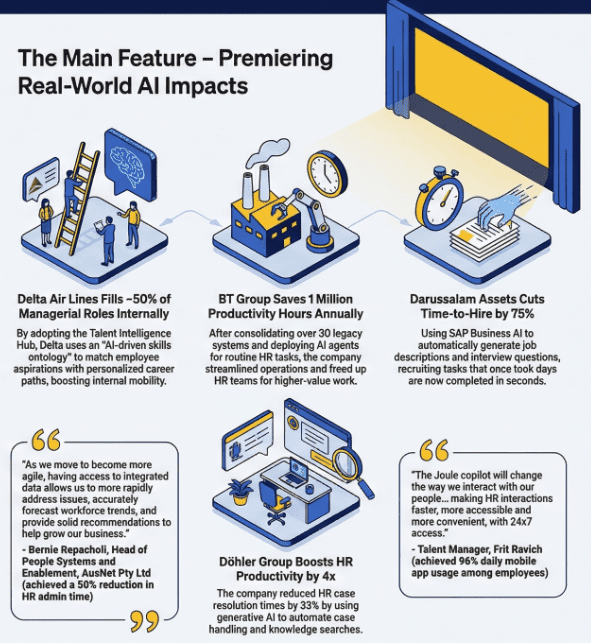
• BT Group, the UK’s leading telecommunications provider, laid its foundation by consolidating over 30 aging IT systems and 200 different workflows into a single “My HR” platform. This foundational work created the data accuracy and operational efficiency needed for reliable AI, saving 1 million productivity hours annually in the process.
• AusNet, a critical energy network provider in Australia, unified 38 disparate processes into a single integrated HR system. This move was about more than just efficiency. As Bernie Repacholi, Head of People Systems and Enablement, stated, “As we move to become more agile, having access to integrated data allows us to more rapidly address issues, accurately forecast workforce trends, and provide solid recommendations to help grow our business.”
b. The Partner Factor: Casting the Perfect Director
Choosing the right implementation partner is one of the most critical decisions in your transformation journey. A great partner doesn’t just install software; they ensure it’s configured for your specific business needs, that your data is clean, and that your team is prepared for change. In implementation reviews written on Raven Intelligence about SAP SuccessFactors projects, customers who rated their partners highly for “scoping accuracy” and “consultant quality” were significantly more likely to realize the full value of their investment. The data shows a stark contrast between SAP SuccessFactors projects, which have a robust partner ecosystem, and the HCM industry average.
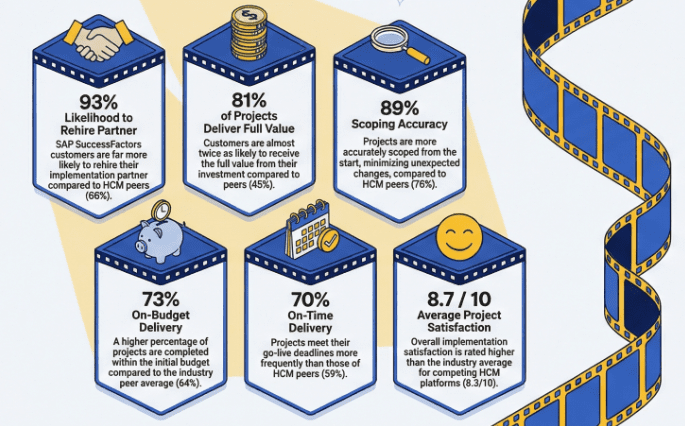
These metrics illustrate that projects involving SAP’s partner ecosystem are nearly twice as likely to deliver their promised business value compared to the industry average. This isn’t just about technical execution; it’s about a partner’s ability to translate a technology investment into measurable business impact.
To help customers cast this critical role, SAP’s Partner Competency Framework categorizes partners into Essential, Advanced, and Expert tiers based on certified expertise and proven customer success, making it easier to identify top-tier talent.
The Adoption Arc & The AI Payoff
A technical deployment is meaningless if users don’t adopt and trust the new system. According to The Josh Bersin Company’s HCM Excellence Maturity Model, the most successful companies move beyond a “Level 1 (Technology-Centered)” focus. They advance to a “Level 4 (Business Transformation)” focus, where the priority is on employee experience, change readiness, and driving significant business value.
The following examples show what becomes possible when organizations make the leap from a Level 1 to a Level 4 maturity. This is the AI payoff that a business-centric, well-adopted foundation enables:
• A New Career Trajectory at Delta Air Lines: Delta’s HR transformation with SAP began back in 2014, establishing a modern HR core that enabled it to later deploy the SAP Talent Intelligence Hub. The result of this long-term vision? Nearly 50% of managerial roles are now filled by internal hires, boosting employee engagement and career mobility.
• Recruiting at Hyperspeed at Darussalam Assets: After a successful implementation of SAP SuccessFactors, this Brunei-based investment holding company embedded SAP Business AI in its recruiting module. The system now automatically generates professional job descriptions and interview questions, leading to a 75% reduction in time-to-hire.
• Revolutionizing HR Services at Döhler Group: As an early adopter of generative AI in HR service management, the global producer of natural ingredients leveraged its solid SuccessFactors foundation to transform its support model. The outcome was a 33% reduction in HR case resolution times and a 4x boost in HR productivity.
• Solving a 10,000-Ticket Problem at PostNL: The Dutch mail and parcel service provider had a strong, modern payroll system in place. This foundation allowed them to confidently adopt the “Ask my Payslip” AI tool to address an anticipated 10,000 annual support tickets, with a projected reduction of 50% to 80%.
These stories are not disconnected anecdotes; they map directly to the foundational pillars discussed. Delta’s internal mobility success is impossible without the standardized job architecture built in 2014. Darussalam’s recruiting speed relies on the clean data and unified processes from its initial implementation. Each AI ‘payoff’ is a direct dividend from an earlier, strategic investment in the fundamentals.
Without a solid prequel–your AI project will fail at the box office
The impressive, headline-grabbing AI success stories are not standalone miracles. They are the sequels, made possible only by the often-unseen prequel: a disciplined, strategic, and well-executed HCM implementation. That foundational work—unifying systems, cleaning data, standardizing processes, and driving user adoption—is the real origin story of AI success.