


The move from legacy ERP systems—often seen as merely a complex ‘System of Record’—to an AI-driven ‘System of Reasoning’ represents the future for UNIT4, a strategic shift that was the main takeaway from an Analyst Summit with Unit4’s Executive Team and customer panel this week in Atlanta.
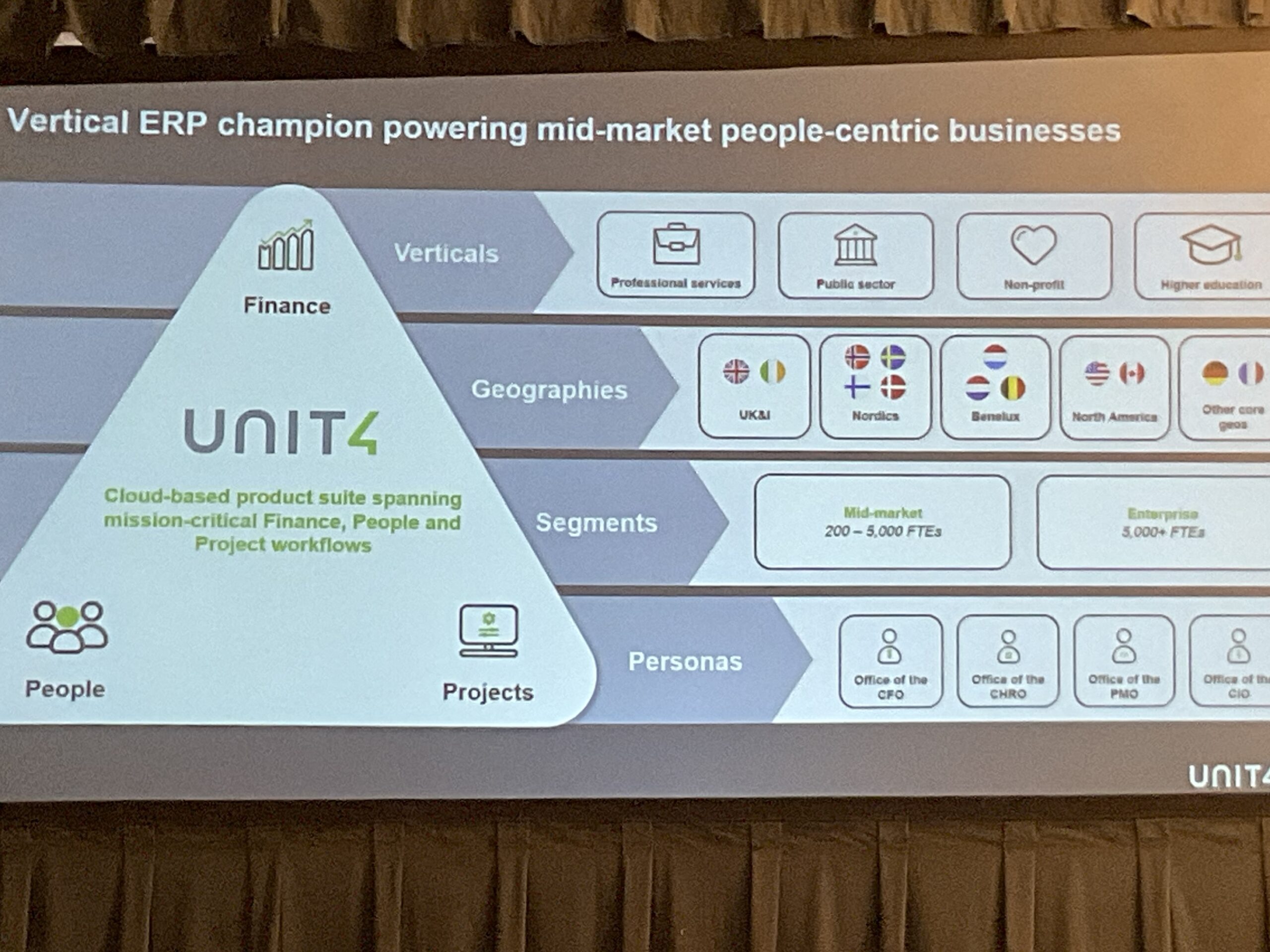
UNIT4’s future goal centered on making ERP systems ‘ambient’—a strategy that addresses the common user indifference toward traditional enterprise software. CEO Simon Paris captured the core challenge: “No one wakes up in the morning and is driven to use their ERP, it’s just not exciting.” Unit4’s solution to this indifference is ‘ambient’ ERP, primarily delivered through their AI assistant, Ava, which aims to minimize friction and maximize utility, a powerful value proposition particularly for the resource-constrained market of People-Centric Industries (Professional Services, Public Sector, Non Profit and Higher Education.)
It is worth noting that throughout the summit, we were provided full access to the Unit4 executives. The customer sessions allowed for open, candid, and unscripted conversations, providing invaluable, real-world insight into the implementation process.
Unit4’s Strategic Pillars: The Path to ERPx Success
The executive session reinforced three foundational strategic pillars that underpin their current and future success:
1. Vertical Centricity is the Core Differentiator
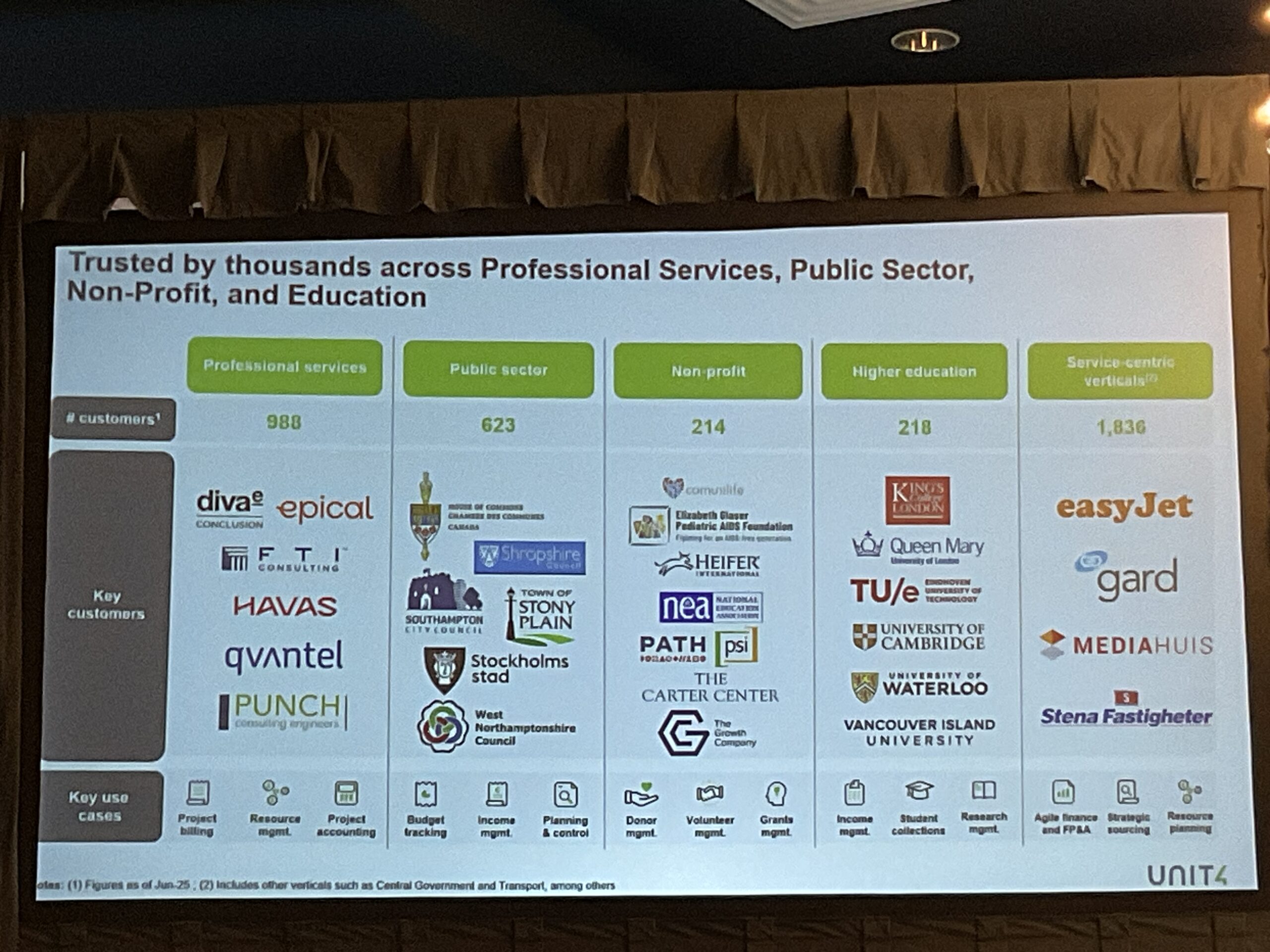
Unit4’s laser focus on 4 People-Centric Industries—Project Services, Public Sector, Higher Education and Non-Profit (NFP)—remains their most significant competitive moat. This is supported by their unique Industry Model, which delivers deep, pre-built functionality tailored to these segments. This focus directly translates into faster implementations and higher out-of-the-box fit, a concept confirmed by the customer panel, particularly in complex areas like financial compliance and project billing.
2. The ERPx Migration Gains Momentum
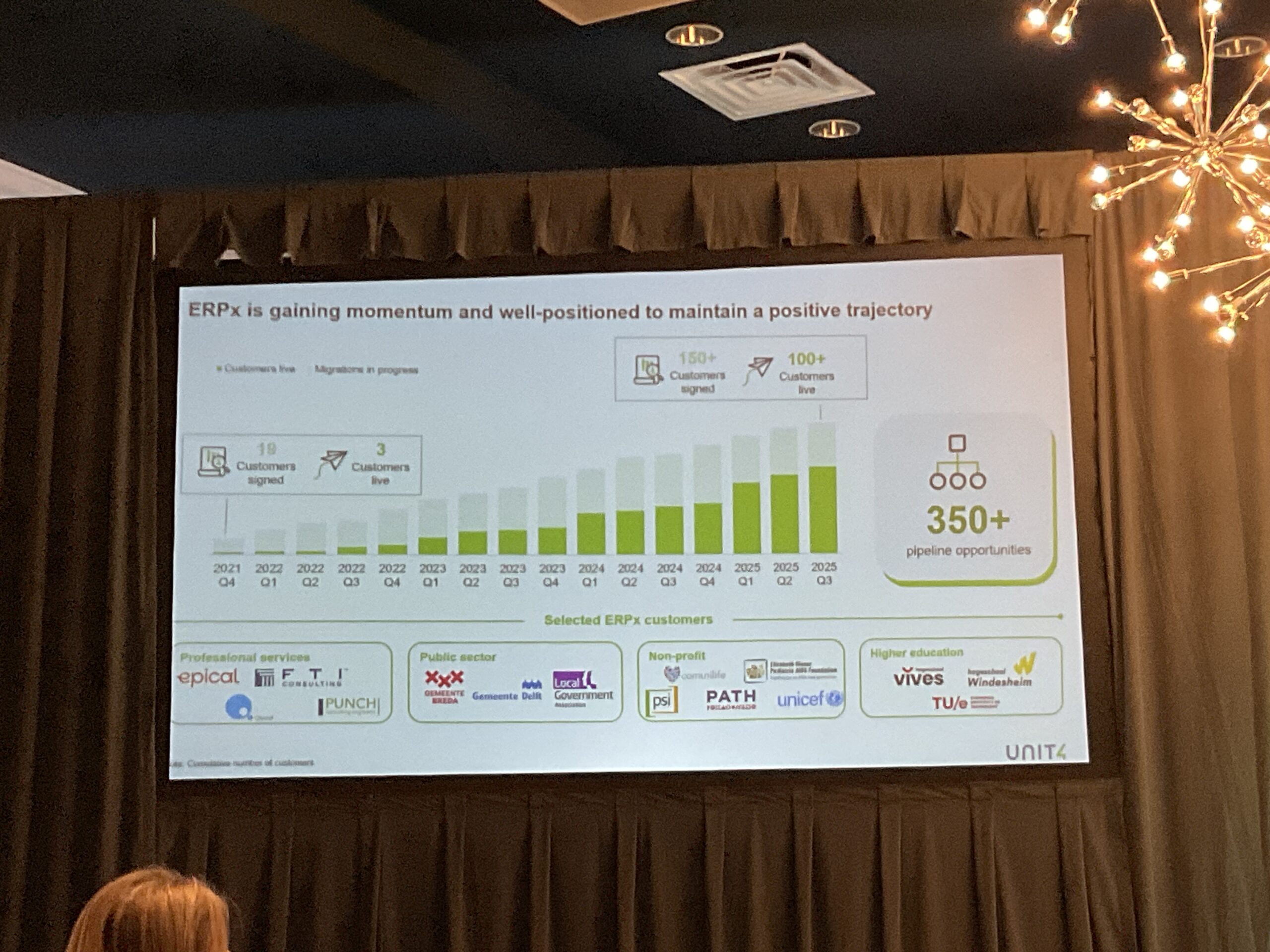
The strategic goal of migrating the customer base to the cloud-native ERPx platform is gaining steam. With over 150 customers already sold and deployments across every target vertical and geography, the technical path appears feasible. Internal analysis showing that 95% of existing customizations are addressable via ERPx’s standard functionality (60%) or the App Studio (35%) de-risks the major pain point of any legacy system migration: the “customization crunch.”
3. Strategic Growth and Cloud Conversion
Unit4 is successfully maintaining strong mid-teens growth while accelerating its cloud conversion—aiming for 90% cloud Annual Recurring Revenue (ARR). This simultaneous push for growth and strategic platform migration is indicative of an underlying operational efficiency that Raven Intelligence sees as crucial for long-term vendor stability.
The SI Partner’s Role: Scaling Migration and Value
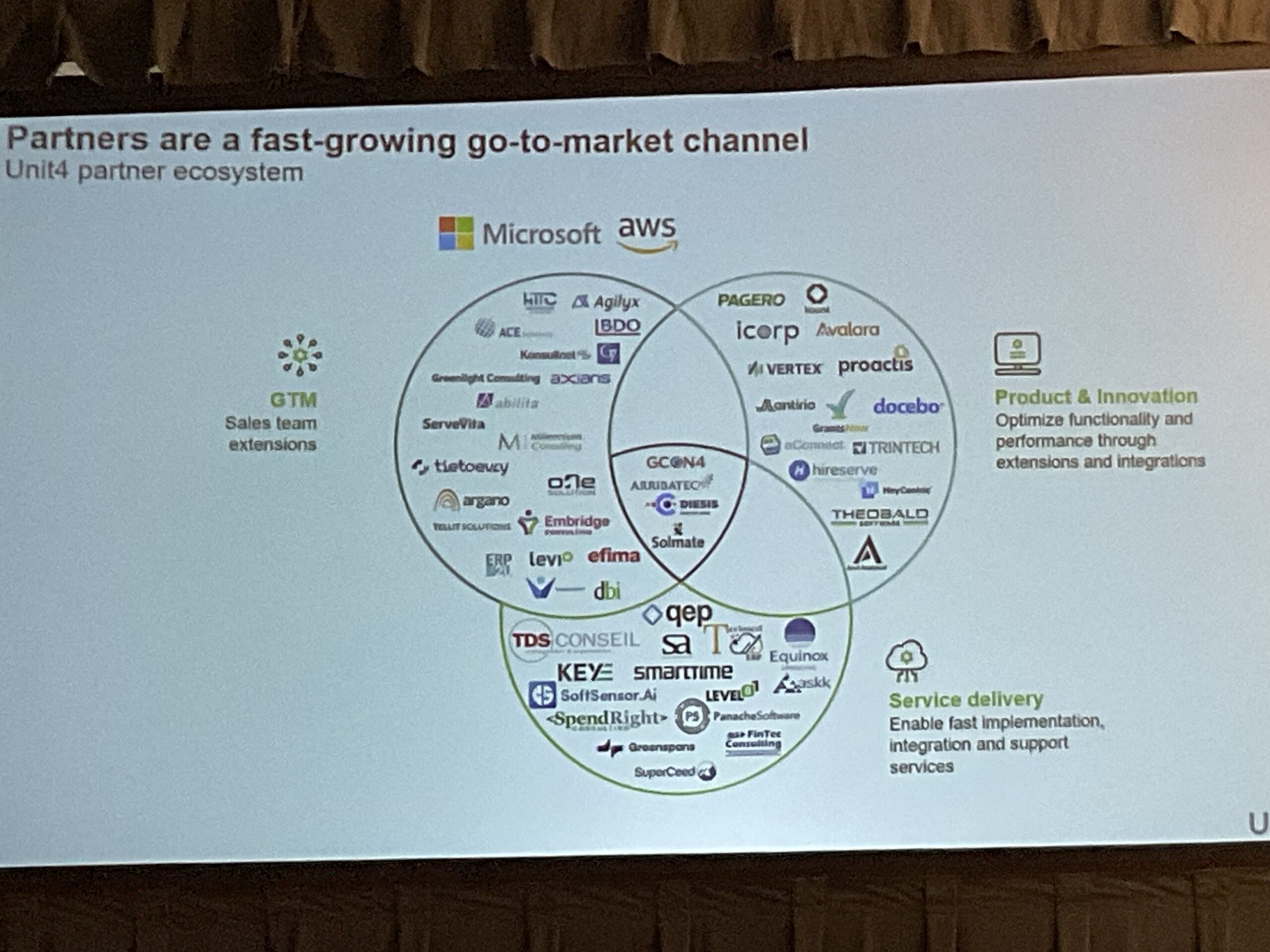
From an SI ecosystem perspective, the logistics of the ERPx migration are paramount. The planned peak of 335 contemporaneous migrations by March 2026 is a massive logistical undertaking. Crucially, the commitment to the channel is evident in the shift in delivery models: 45% of these migrations are being delivered by partners, a significant jump from an initial 2%. This successful channel enablement signals a maturation of the partner ecosystem, which is vital for Unit4’s scalability, particularly in North America, a key target growth region.
The success of the new premium Success4U subscription model, which shows a 50 NPS point improvement for participating customers, highlights a crucial area for SIs: embedding continuous value. The vision for using AI (Ava) to drive “hyper-personalized, industrialized scale” engagement for the long tail of customers is a strong path toward minimizing churn without relying on an unsustainable expansion of the Customer Success Manager (CSM) headcount, a challenge every enterprise software vendor faces.
Customer Panel Insights: The Reality of ERP Value
The customer panel featuring Alan Doyle, Director of Corporate Systems at PSI; Angela Grigoryan, CFO at Comunilife; Brendan Keaton, Chief Accounting Officer and Controller at FTI Consulting; and Claudia Juarez, Director of Business Systems at PATH provided unfiltered insight into the true value, challenges, and implementation realities of the Unit4 ecosystem.
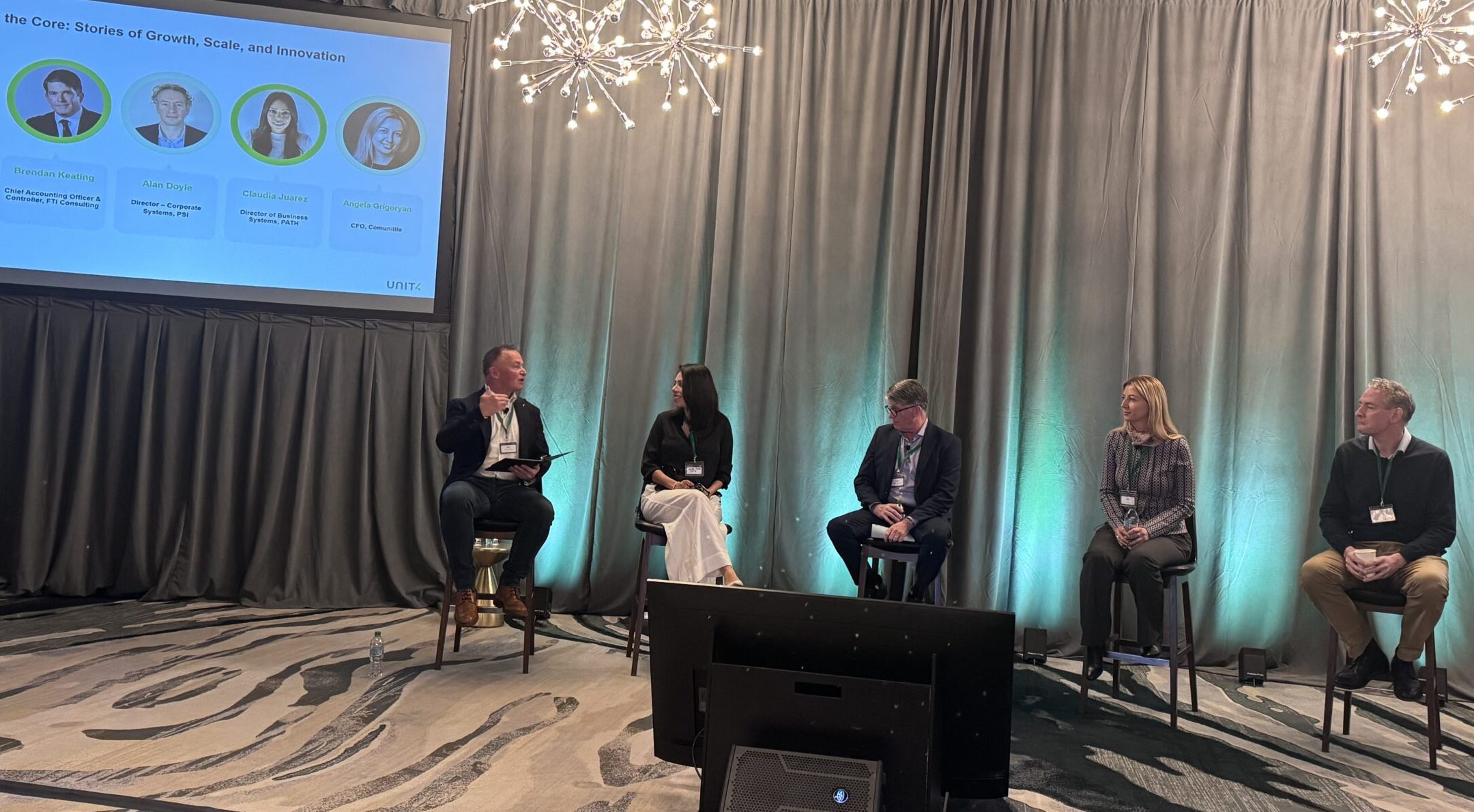
The “War Story” of Implementation
The panelists offered honest critiques that should serve as crucial guideposts for SIs:
• Change Management is the Biggest Barrier: Claudia Juarez (PATH, Director of Business Systems) stressed that the major challenge was not technical, but change management and user adoption, noting the struggle to overcome “comfortable compliance” with old, manual ways. This underscores the need for SIs to be change management and business process experts, not just technical implementers.
• The Problem of Optimism: Brendan Keaton (FTI Consulting, Chief Accounting Officer and Controller) noted their timeline was “wildly optimistic,” taking over three years instead of the anticipated year and a half. This reiterates the Raven Intelligence finding that ERP timelines are routinely underestimated, especially in complex, acquisitive environments. SIs must incorporate a more realistic contingency for complex functionality like billing and inter-company invoicing.
• Standardization is the Reward: Angela Grigoryan (Comunilife, CFO) highlighted the foundational value of the process: forcing the organization to move from archaic, manual, paper-based processes to standardized, systematic ones. The implementation itself acts as a crucible for necessary business transformation.
Quantifiable Value Realized
The benefits realized directly map back to Unit4’s vertical focus:
• Automation of Complex Allocations: For NFP organizations, Claudia Juarez (PATH) cited the automation of cost allocation across hundreds of projects and funders as the “most beneficial” outcome. This process, previously manual with “hundreds of Excel spreadsheets” and taking months, now allows them to close by the 10th of the month.
• Inter-Company Automation: Brendan Keaton (FTI) emphasized the automation of global project inter-company invoicing, a task previously complex and manual, alongside improved compliance through localization features for statutory reporting and VAT.
• Real-Time Data for Decision Making: Angela Grigoryan (Comunilife) cited the consolidation of disparate field management systems into a single engine, providing real-time data and empowering non-technical users to build forms and reports.
The Future of AI in ERP: Practical and Transactional
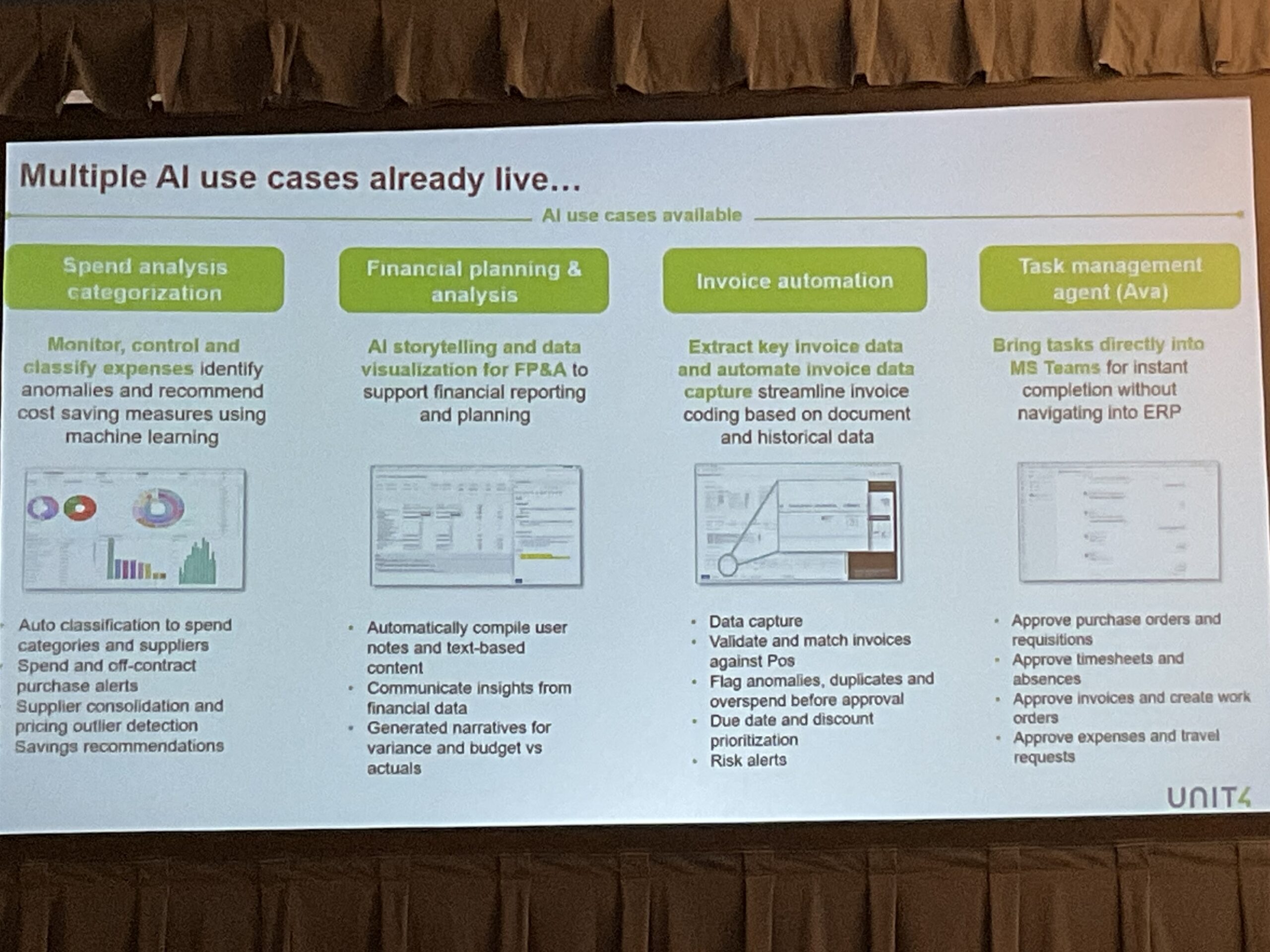
The panelists’ vision for AI was pragmatic, focusing immediately on reducing manual, transactional effort, proving Unit4’s ‘System of Reason’ concept resonates on the ground:
• AP and Cash Application: Angela and Brendan both cited Accounts Payable (AP) processing (e.g., invoice handling and approval routing) and cash application as the near-term focus to reduce manual work and refocus staff on higher-value tasks.
• Intelligent Insights: Claudia sees AI as crucial for resource-constrained organizations to “do more with less,” specifically by providing intelligent insights like flagging unusual budget transactions to financial administrators.
The ultimate KPI for customers like Claudia and Brendan is the reduction in labor hours/time saved for key processes like month-end closing, allocations, and non-standard transactions—a metric that SIs should integrate into every Statement of Work.
Wrap-Up: A Clear Vertical Path
Unit4’s commitment to an AI-led, friction-free ERP experience, tailored for People-Centric Industries, is their unique strategy. The success of the customer panel in achieving quantifiable benefits—from 10-day month-end closes to global inter-company automation—validates the core vision.
For their SI partners, the message is clear: the opportunity is scaling the complex ERPx migration and embedding continuous value through advanced, process-centric consulting, focusing on the reduction of labor hours (ROI) and improvement of user satisfaction (adoption). The transition from a ‘System of Record’ to a ‘System of Reasoning’ will hinge on successful projects and implementations.