


Q2 2026
VERIFIED REVIEW ANALYSIS
Every quarter we read the full text of what customers write about their implementations, not just the scores. This quarter’s set — 287 verified post-go-live reviews across eight ecosystems — skews toward engaged projects, because writing several hundred words about your implementation is something people mostly do when they have something to say. So the useful signal isn’t how often things went well. It’s what customers who got what they wanted still told us they’d change.
What’s Improving
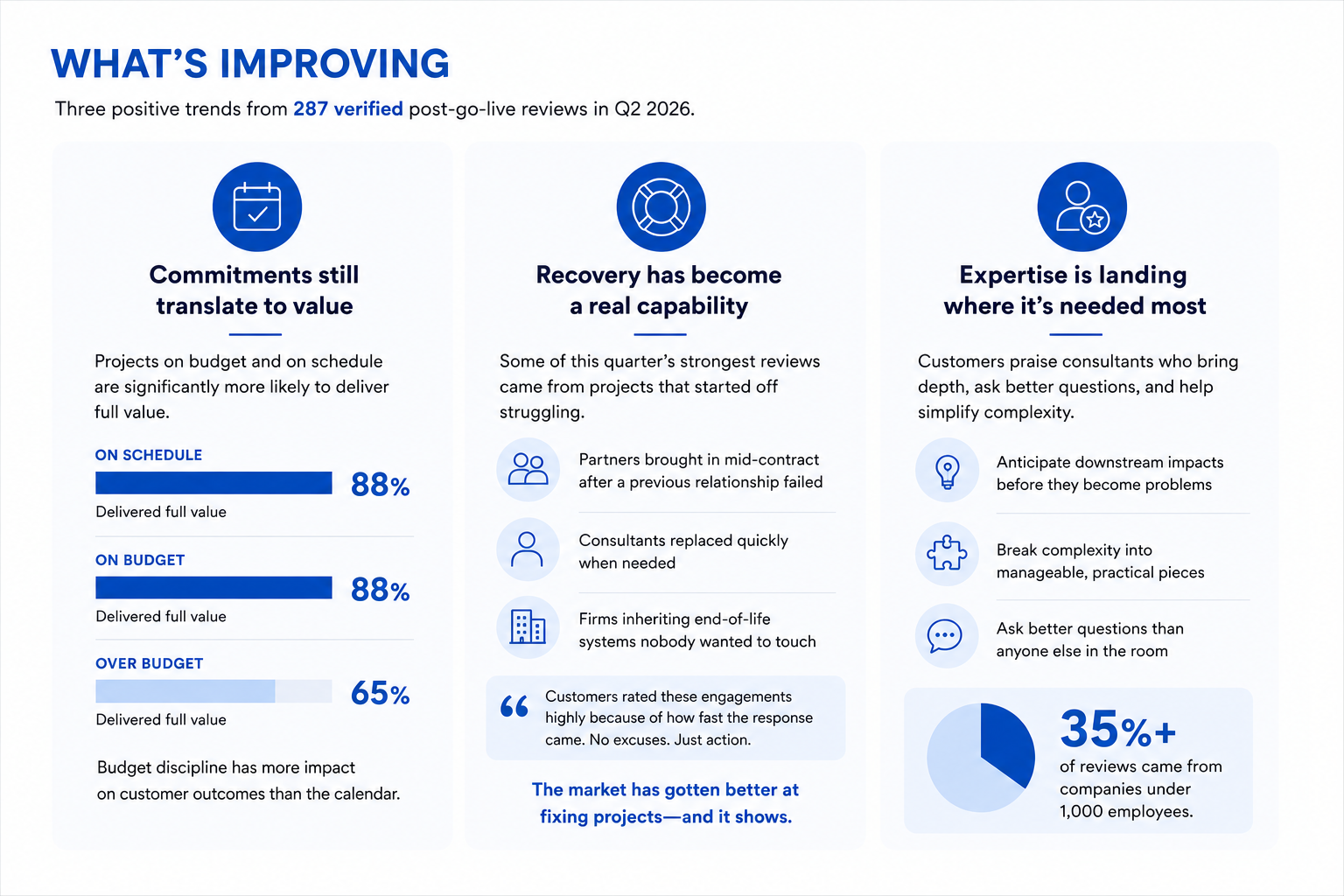
Hitting commitments still tracks with delivering value — and budget matters more than the calendar. Projects that landed on schedule reported full value 88% of the time; those that slipped, 73%. On-budget projects hit full value 88% of the time against 65% for those that went over. A missed date doesn’t doom a project — most late projects still delivered full value. A blown budget does more damage, and it does it to the customer’s perception of what they got, not just their finances.
Recovery has become a real capability. Several of the strongest reviews this quarter weren’t clean projects. They were rescues: a partner brought in mid-contract after a previous relationship failed, a consultant swapped out at the customer’s request and replaced within days, a firm inheriting an end-of-life system nobody wanted to touch. Customers rated these engagements highly not because nothing went wrong, but because of how fast the response came. One reviewer put the standard plainly — the partner didn’t make excuses or leave them to figure it out alone. The market has gotten better at fixing projects, which is its own kind of maturity.
Expertise is landing where it’s needed most. The praise in these narratives is strikingly specific and almost always about depth rather than process. Customers describe consultants who anticipated downstream impacts, who knew the product well enough to break complexity into manageable pieces, who asked better questions than anyone else in the room. Smaller organizations in particular — over a third of this quarter’s reviews came from companies under 1,000 employees — described partners as the reason a project was survivable at all.
What’s Not Improving
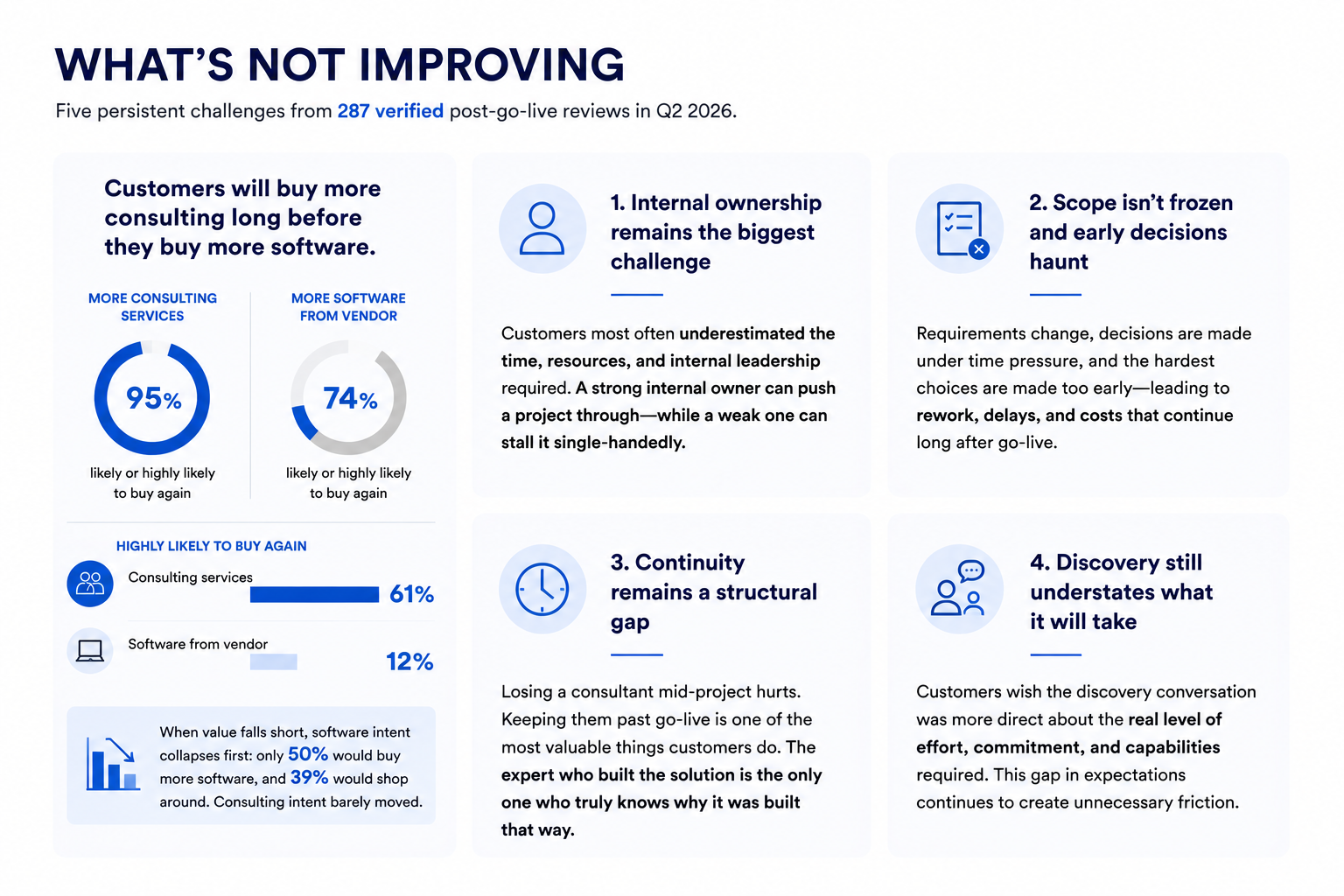
Customers will buy more consulting long before they buy more software. This is the sharpest split in the data. Ninety-five percent of reviewers said they were likely or highly likely to buy more consulting services. Only 74% said the same about more software from their vendor. Dig into the intensity and the gap widens: 61% were highly likely to buy more consulting, versus 12% highly likely to buy more software.
Read that again, because it inverts the usual assumption about where implementation goodwill accrues. Customers finish these projects trusting the people who did the work substantially more than the platform they did it on. Several narratives make the mechanism explicit — reviewers describing a vendor’s support model as lacking while crediting their partner with filling the gap, or noting they’d choose their consultant over the vendor’s own support desk for routine work. When value falls short, software intent collapses first: among partial-value projects, only 50% would buy more software, and 39% said they’d shop around. Consulting intent barely moved.
The internal side is still the unmanaged variable. The most common regret across every satisfaction tier is some version of we underestimated what this would take from us. Customers described being surprised by the time commitment, wishing they’d dedicated a stronger internal lead, recognizing that a strong internal owner can push a project through and a weak one can stall it single-handedly. One reviewer, from a small organization, said flatly they hadn’t expected the scale of commitment and wished the discovery conversation had been more direct about it. Nobody sells against their own deal in discovery — which is precisely why this keeps happening.
Scope still isn’t frozen, and foundational configuration decisions still haunt. Where projects went over budget or behind schedule, the narratives rarely blame estimation. They describe requirements that stayed fluid, structural decisions made under time pressure that generated years of rework, and a general sense that the hardest choices got made before anyone understood their consequences. One reviewer described being forced into a business structure requiring constant updates — a decision made early that they were still paying for.
Continuity remains a structural gap. The pattern shows up in two directions. Customers who lost a consultant mid-project felt it immediately. Customers who kept one past go-live said it was the single most valuable thing they did. One reviewer’s advice was to keep the implementer engaged through at least the first quarter of live operation rather than handing off to a general support queue, because the person who built the configuration is the only one who knows why it was built that way. Very few commercial models are structured to allow this.
What Customers Said They Would do Differently
Four things, in rough order of how often they came up.
- Start Earlier — and not on the parts you think. The most common concrete regret was sequencing. Reviewers wished they’d loaded data for testing sooner, run parallel workstreams instead of sequential ones, finalized file specifications and identified third-party contacts before kickoff rather than during. The wish is almost never for more total time. It’s for the front of the project to have been less ceremonial.
- Name one accountable internal owner and give them the time. Not a committee, not a split-duty assignment. Reviewers who had this said so; reviewers who didn’t identified it as what they’d fix. This is the variable most fully inside the buyer’s control and the one most frequently conceded.
- Be honest about your own team’s gaps. One of the more useful reviews came from someone who realized too late that their partner had assumed a level of domain expertise they didn’t have — and who concluded the fix was on their side: communicate your team’s actual experience level upfront rather than letting the partner infer it. Several others echoed the shape of it. Partners calibrate to what you tell them.
- Do the diligence on the partner, not just the platform. The most pointed lesson of the quarter came from a customer whose implementation partner and follow-on consultants were different firms with dramatically different results. Their conclusion: research the implementation partner heavily and call references, because they set the tone for everything downstream. Another put it more bluntly — always have someone on your side, and don’t assume the vendor will weigh your interests first.
The Through Line
The single most consequential number here is the gap between 95% and 74%. Customers leaving these projects are more committed to their partners than to their platforms, and the narratives explain why: when something went wrong, it was usually a person who fixed it.
That should be uncomfortable for everyone. For software vendors, it’s evidence that the implementation experience is where platform loyalty is won or lost, and it’s currently being won by somebody else. For services firms, it’s a warning that the goodwill is attached to named individuals rather than to firms, nearly every piece of praise in this dataset names a person. And for buyers, it’s the clearest possible argument for treating partner selection with the rigor usually reserved for software selection. Much of the value you’re buying arrives through people whose names aren’t in the contract.
Ready to make better implementation decisions?
Explore 4,700+ verified customer reviews, compare consulting partners, and discover what customers wish they’d known before their projects began. Every quarter we analyze hundreds of verified implementation reviews to uncover the trends shaping enterprise software projects.
Stay up to date with:
- Quarterly implementation insights
- Industry benchmark reports
- Verified customer reviews
- Partner rankings and buyer resources